“Our victims know us by their scars and their chains, and it is this that makes their evidence irrefutable. It is enough that they show us what we have made of them for us to realize what we have made of ourselves.” -Jean-Paul Sartre: from: Frantz Fanon-The Wretched of the Earth
By all accounts, Darnell Hamilton is an extremely bright young seventeen year old African-American male. Darnell attends Chicago’s celebrated Urban Prep Charter Academy’s West Side campus. The non-profit charter school boasts three campuses with an enrollment of 2,000 students, 85% of whom qualify for free or reduced lunches.[1] However, the school is more widely known because, for the fourth year in a row, 100% of the schools graduating seniors were accepted at four year colleges or universities. On March 28, 2013, Chicago’s Mayor Rahm Emanuel joined in celebration with the graduating seniors who were accepted to over 120 different colleges and universities.[2] Emanuel, who this year closed fifty Chicago public schools, has at the same time launched a strong push for the expansion of charter schools which are a central focus of his school reform efforts.
In his junior year at the school, Darnell holds a grade point average of 4.0 and already has been promised a scholarship to Ohio State University.[3] In order to attend Urban Prep, Darnell faces the same challenge as many Chicago area students. Each day as he makes his way to school, on public transportation, he risks being confronted or recruited by area gangs. Yet, despite his tenacity, determination and academic success, Darnell may not be counted among those graduating seniors next year due to the fact that he made an extremely poor decision that could impact the rest of his life.
Facing harassment from gangs, the fearful seventeen year old bought a 9 mm gun, carried the weapon into school inside his book bag and placed it in his locker where it was later discovered. Darnell was arrested, charged with two felonies, given a $75,000 bond for unlawful use of a weapon (UUW) and possession of a gun on school grounds. Darnell and his own mother acknowledge his mistake and know that he should never have armed himself.[4]
In light of the number of school aged children who have been killed or wounded by gunfire in Chicago, the ensuing pleas of community residents for safety, one can hardly question the process that led to notifying police officials, Darnell’s arrest, or the desperate search for solutions to gun violence. However, as the facts have presented themselves thus far, Darnell was neither in a gang nor seeking to join one, rather he rejected gang life as he sought for himself a brighter future (or any future at all).[5] The stories of individuals like Darnell matter—especially when our search for solutions leads to the creation of public policy.
It is unlikely that Mayor Emanuel had persons like Darnell Hamilton in mind when pushing for a new three year mandatory minimum sentence for all people caught carrying a gun illegally.[6] The mayor, in supporting such legislation, may be responding to the strong pleas for increased community safety (which remains a challenge in Chicago’s community neighborhoods). Still, public policy matters. Public policy impacts the lives of individuals like Darnell, his family, and the wider community for years and decades to come.
Darnell Hamilton could easily serve as a poster child for the failure of our criminal justice system. He is someone for whom we might easily even feel a great deal of sympathy. However, there are literally thousands of young people sitting in correctional facilities, such as Chicago’s Cook County jail, who have not received the attention or support that has been garnered for Darnell Hamilton. Many of these young people have been charged with non-violent offenses (70 percent) or are first time offenders. Many of these young people do not hold 4.0 grade point averages and are not enrolled in elite schools but come from underperforming schools if any. Many of these young people are persons we might even deride or despise. We might even fear them just as Darnell feared the gangs that he encountered. I would even venture to say that many of them are guilty.
Like Darnell, many come from families that face significant economic challenges and are from communities of color. Regardless of their guilt or innocence they too need advocates to stand with them, to speak out on their behalf when they cannot speak, and to work against the unjust conditions, laws and systems that ensnare them. Their future is our future.
Attempting to address serious and complex social issues of violence and crime and yielding to public pressure for immediate quick solutions by enacting legislation such as mandatory minimums may serve a political end, but it is an extremely poor decision causing great harm with lasting ramifications to individuals and communities.
The Cook County Jail, located on 26th & California, has a long and infamous history in the county and the city of Chicago. In 1928 the jail held 3200 residents when it was first constructed to replace previous facilities as a result of Chicago and the county’s growing population and associated crime. The current structure (Cook County Department of Corrections) now holds an average of 9,000-10,000 residents on any given day and the extremely overcrowded and the jail has been found to be in violation of the residents 8th amendment rights (including excessive bail/bond, torture and cruel and unusual punishment regardless of the crime that may have been committed).
Ninety (90) percent of those in the jail are awaiting trial but not been tried or convicted of the offense for which they have been charged. They are unable to pay the high bails/bonds that have been set. In other words they are poor people of color. Eighty-six (86) percent of those incarcerated at the jail are African-American or Latino/Hispanic. Of the youth population at the jail African-American and Latino/Hispanics comprise ninety percent. The Illinois Juvenile Justice Commission has documented Disproportionate Minority Contact across the criminal justice system.
Perhaps the most insidious omission in much of the debate surrounding the mandatory minimum legislation is that it ignores, according to Kollman and Nong, “Illinois’ two existing mandatory gun sentences: one for possession during a crime and one for possession alone. Gun enhancements known as ’15/20/25-to-life’ mandate minimum 15-year sentences when a person in possession of a gun commits any felony offense, whether or not the offense is violent or the gun is actually used in furtherance of the crime (e.g. check fraud, drug possession).”[7]
However, we are not powerless in the face of these destructive forces. Religious institutions, community organizations, legal clinics, and racial justice advocates have already begun to wage a legislative advocacy campaign[8] calling on the Cook County system to reduce violence by funding community based restorative justice efforts, mental health and drug rehabilitation alternatives through funds saved by releasing non-violent pre-trail detainees.
There are resources at our disposal that can address many of the challenges that our communities face. Restorative justice models provide a vehicle for building community and making communities safer by bringing stakeholders[9] together in preemptive ways to disrupt violence. Robert J. Sampson, in “What ‘Community’ Supplies” calls for a sense of urgency, a sense of possibility, a sense of equity, and a sense of inevitability in mobilizing diverse stakeholders for community action.
Similarly, by bringing together offenders, victims and community residents who are harmed not only by crimes that are committed but also the policies that have led to hyper-incarceration in communities of color, restorative justice brings healing and restoration where relationships have been damaged or broken. Examples of restorative justice practices in our campaign include peace hubs, drum circles, conflict resolution counseling and community services. The Reclaim Campaign calls for one third of every dollar of funds used to incarcerate to be spent on mental health and drug rehabilitation, one third of every dollar to fund restorative justice, and one third of every dollar to Cook County’s use.[10]
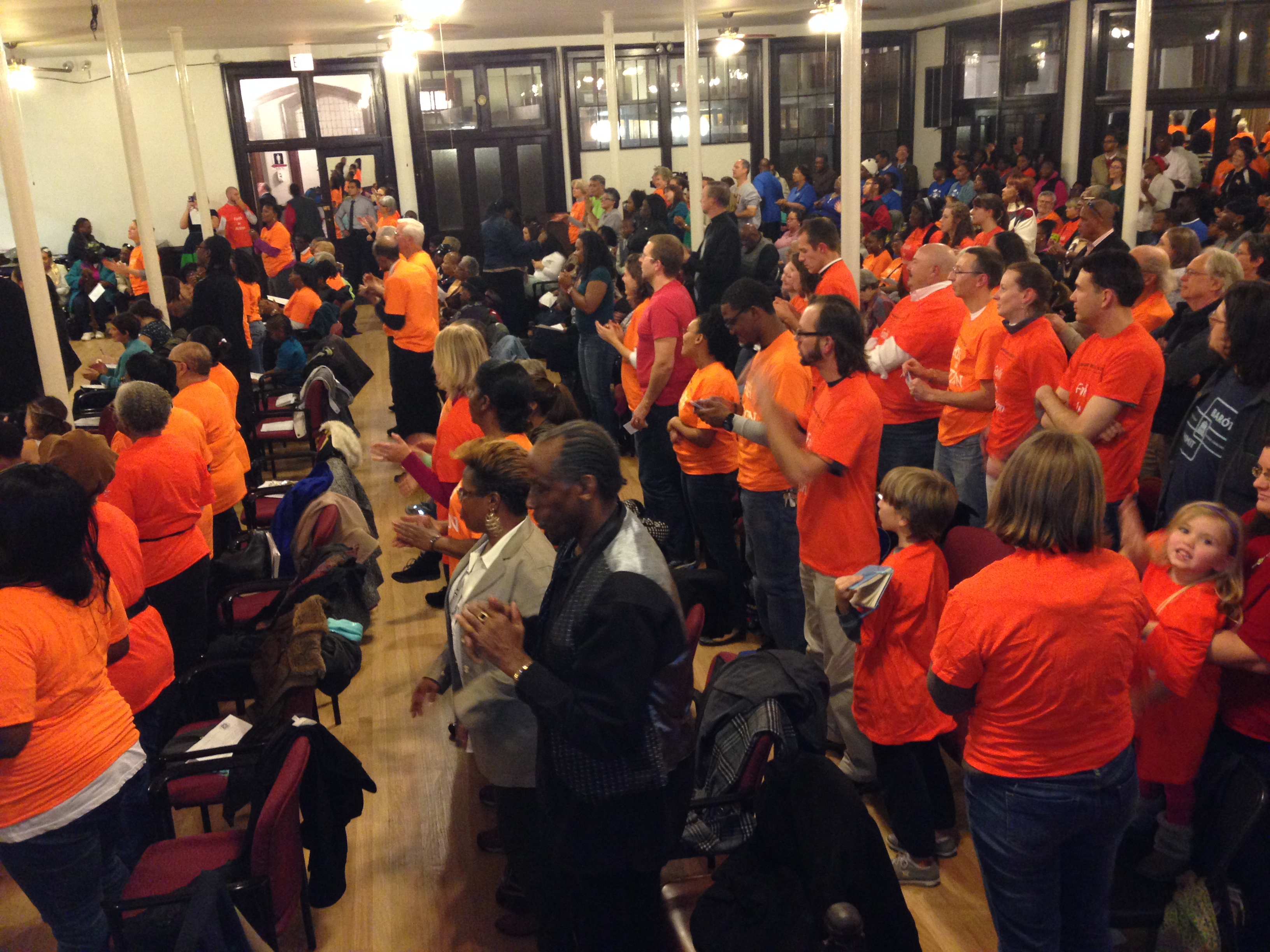
Sustaining public action will be essential to defeating not only the proposed mandatory minimums but to educate the public about mass incarceration. Due to opposition from elected officials who met with constituents and religious leaders opposed to the legislation it currently does not have the votes or support to be called to the floor of the Illinois General Assembly. In addition to submitting testimony and advocating with legislators advocacy with media and editorial boards are helping to defeat the measure. Following a public action of over 300 people one journalist Robert C. Koehler wrote that,
“The Reclaim Campaign begins at a legally embedded obscenity. Our retributive criminal justice system is eating black and Latino communities alive, spending enormous sums of money to warehouse primarily men and women of color, who have been not been convicted of anything and for the most part have been charged with nonviolent offenses, for long periods of time. The system wastes money, wastes, lives and keeps certain communities perpetually shattered.”[11]
“You shall not render an unjust judgment; you shall not be partial to the poor or defer for the great; with justice, you shall judge your neighbor.” Leviticus 19:15
I encourage you and your institution to take action by contacting your legislators visit the “Reclaim Campaign”
http://www.communityrenewalsociety.org/node/591
[1] According to Urban Prep Academies, over 85% of their students qualify for free/reduced lunch and many come to the school several grade levels behind in core subjects. www.urbanprep.org/schools (accessed November 2, 2013).
[2] While it is not within the scope or purpose of this paper it should be noted that Urban Prep Academies is not without its critics who question the claims, myths, and narratives regarding the school as a model for structural change as well as the complex issue of charter schools.
[3] Rosemary Regina Sobol, “Urban Prep Junior Charged with Bringing Gun to School,” Chicago Tribune, September 25, 2013 http://articles.chicagotribune.com/2013-09-25/news/ct-met-student-charged-gun-20130926_1_school-bag-school-uniform-hamilton (accessed November 1, 2013)
[4] Sobol, “Urban Prep Junior Charged”
[5] The issue of gang recruitment of juveniles to commit crime remains a serious and complex issue. While it is beyond the scope of this paper, there is anecdotal evidence of Chicago gangs exploiting juveniles to commit serious crimes including high-profile crimes.
[6] With the support of Mayor Rahm Emanuel, House Bill 2265/Senate Bill 1342 was recently introduced to the Illinois General Assembly with the goal of imposing a mandatory three-year minimum prison sentence for people convicted of illegal use of a weapon.
[7] Kollman and Nong, “Combating Gun Violence”, 13
[8]“ The Reclaim Campaign” includes not only faith based community organizing and religious institutions but partners with legal scholars and researchers to develop and utilize best practices and evidence-based solutions.
[9] Compare Robert J. Sampson, “What ‘Community’ Supplies”. Sampson calls for a sense of urgency, a sense of possibility, a sense of equity, and a sense of inevitability.
[10] “The Reclaim Campaign” of the Chicago Community Renewal Society and Gamaliel Foundation.
[11] Robert C. Koehler, “Reclaiming ‘Chiraq’ with Restorative Justice” Common Dreams. November 14, 2013 (accessed online November 14, 2013).
 Just Peace Cafe
Great !!!!!!
Richard Mosley, Jr.
>